WSA’s Rebout attends tour, discussion with Sen. Baldwin
Share This
When it comes to trade and the impact of tariffs, Wisconsin soybean farmers have worn thin. But for the Wisconsin Soybean Association, the topic, however exhausting, is one of the many hurdles the organization works on with members of Congress.
“It’s important that we take the time to discuss the impacts of federal policy on the farming community, said Doug Rebout, president of WSA.
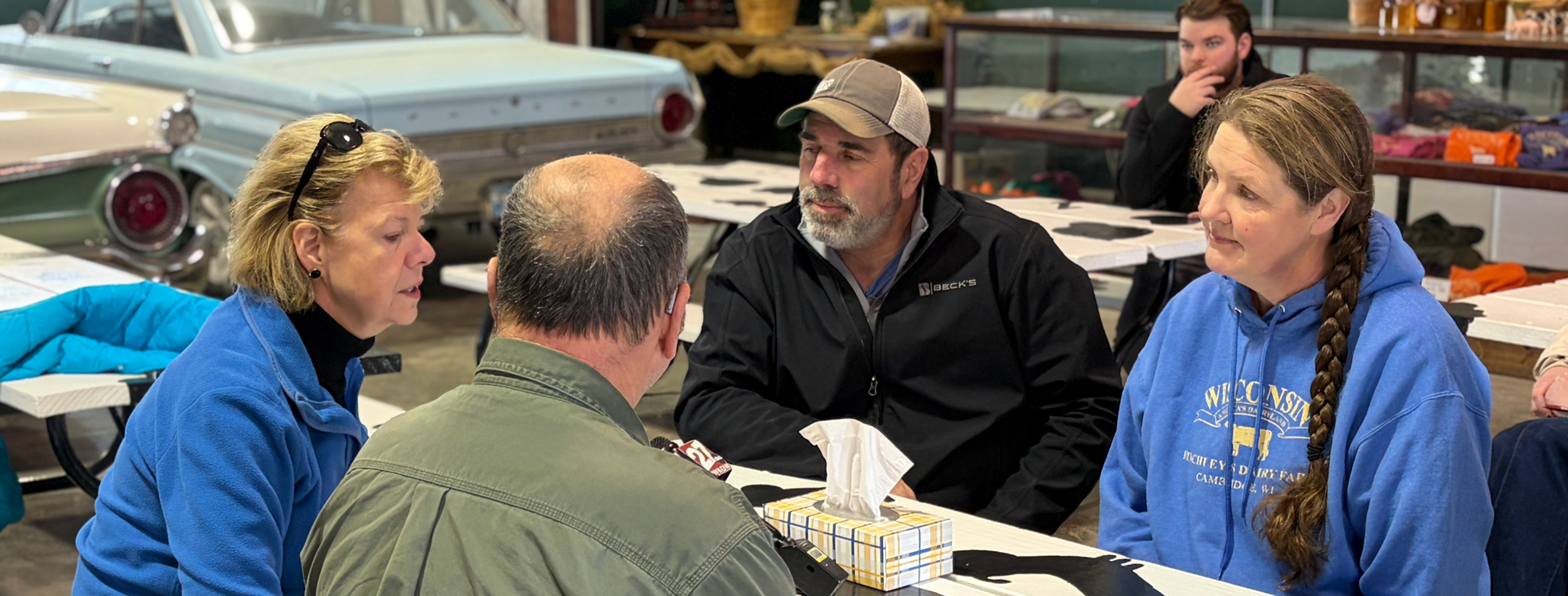
Rebout joined the Hinchley family today at Tina and Duane Hinchley at the Hinchley Dairy Farm to host Tammy Baldwin for an on-farm discussion focused on the real-world impacts of trade wars, tariffs and the rising costs of inputs for Wisconsin soybean farmers.
The visit provided an opportunity for farmers to explain how global trade policy decisions made in Washington directly affect farm profitability, long-term planning, and rural communities across the state.
Duane Hinchley pointed out that it took decades, farmers and commodity organizations invested time and resources building global markets for U.S. soybeans — particularly in China.
“That market took more than 20 years to develop and, at its peak, accounted for roughly 65 to 70 percent of U.S. soybean exports,” said Michael Slattery, who farms near the Hinchleys and attended the discussion. “It took decades to build these markets. We’re watching them unravel far faster than they were ever created.”
Rebout said China typically purchases about 25 million metric tons of soybeans annually, but recent commitments fall far short of that level. Farmers expressed concern about the lack of transparency surrounding trade agreements, noting that without clear terms and accountability, producers are left navigating uncertainty while making multi-year investments.
Global competition has intensified those pressures. Soybeans shipped from Brazil often reach export markets at a significantly lower cost than U.S. soybeans, and retaliatory tariffs further widen that gap.
“We don’t want government checks,” Duane Hinchley said. “We want markets. Wisconsin soybean farmers can compete when the playing field is fair.”
At the same time, Rebout said, input costs continue to rise. Equipment prices have surged due to steel tariffs and supply-chain disruptions. Fertilizer costs — particularly potash imported from Canada — have increased sharply. Replacement parts that once arrived quickly now take weeks or months, forcing farmers to travel long distances just to keep equipment running.
Those challenges ripple beyond the farm gate.
“When farm dollars disappear or are spent outside local communities, rural businesses feel the impact immediately,” Rebout said.
Some suggest farmers should simply grow different crops. Duane Hinchley pushed back on that notion, noting that corn and soybeans represent millions of dollars in specialized equipment, infrastructure, contracts and expertise — with few viable alternatives at scale.
“You can’t flip a switch and change what you grow” Rebout said. “The investment, knowledge, and markets are already in place.”