Soy Forward: Lutz retires from WSA, ASA with legacy fulfilled
Share This
This story first appeared in the Winter 2026 issue of Soy Forward.
By Drew Lyon
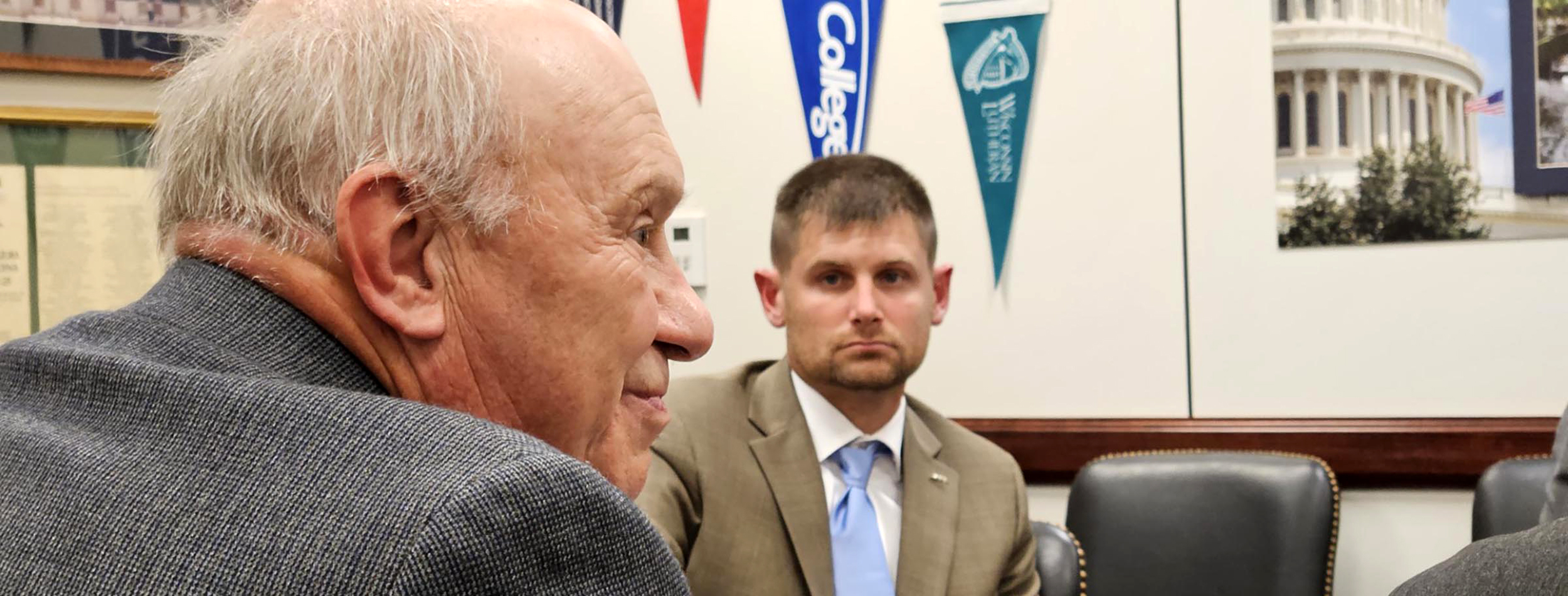
Don Lutz gathered his share of policy and economic wisdom across three decades with the USDA and another 13 years advocating for farmers in his role on the Wisconsin Soybean Association.
He’s eager to share insights from the trenches. For starters: Sometimes, the best offense is a good defense.
“I guess I’ve been involved enough around government to know that if you want something done, you’re going to end up having to speak up for yourself,” Lutz said. “A lot of times it’s not what they do for you; it can be what they do to you.”
Lutz invested that knowledge across nine impactful years representing Wisconsin on the American Soybean Association (ASA), promoting farmers’ conservation efforts and myriad farm-related policies, including the Farm Bill, biofuels policy, trade, technology, rural health care, transportation infrastructure and value-added uses for soy.
“I’m a big advocate for developing new products that use our soybeans,” he said. “I’d love to see biodegradable plastics and things like that that could be fashioned out of soybeans, and the soy-based firefighting foam.”
The soft-spoken Lutz might not have ever been the loudest person in any room when a policy discussion was taking place. But, through his combination of farming experience and data intelligence, Lutz might well have been the smartest person in the room.
His farmer pupils took notes from the teacher.
“I’ve never met anybody as thorough as Don about getting the details correct about statistics and figures,” said ASA Treasurer Tanner Johnson, who served alongside Lutz on ASA from 2021-2025. “The way he studies numbers and can remember numbers has just always wowed me. I’ve always looked up to him and his service, and he has a very keen eye for accurate data, which I’ve always really appreciated.”
December 2025 marked the end of an era for Lutz and the Wisconsin Soybean Program. During ASA’s board meeting in St. Louis, grower leaders and ASA staff recognized Lutz for nearly a decade of leadership representing Wisconsin’s soybean farmers in Washington, D.C.
“Don has been one of the most involved and thoughtful members of the ASA board,” ASA CEO Steve Censky said. “He represented Wisconsin soybean growers earnestly, always taking part in important policy discussions and bringing good perspectives. Additionally, his insights on USDA and ag data collection from his career at the National Agricultural Statistics Service were invaluable. Don’s service to his fellow soybean farmers has made a positive and lasting impact for our industry.”
Chasing profit, not yields
Lutz was born and raised in Amherst in Wisconsin’s Central Sands on a farm just across town from where he farms today on irrigated land in Scandinavia, Wis., with his brother, Dale, and nephew, Miles, on a fifth-generation farm. In the 1970s, Lutz attended University of Wisconsin-River Falls, graduating with a bachelor’s degree in ag education and animal science, and a master’s degree in ag economics. In 1976, Lutz began a 35-year career with USDA’s National Agricultural Statistics Service (NASS). He was placed in South Dakota for 18 months before being relocated in 1978 to Illinois. By the early 1980s, Lutz noticed the increase of soybean acreage across Illinois and took the initiative in becoming one of the first operations in the Central Sands to plant soybeans.
“I thought, well, why couldn’t we raise some of those soybeans and help spread our workload out a bit?” said Lutz, who rotates soybeans and corn and also raised four children with his wife, Charlotte. “Soybeans had potential, I could see that. We were beginning to see in the late ‘70s, early ‘80s, some of the struggles that dairy was having and that there would be some opportunities to do some new things and that soybeans would be one of those opportunities.”
After eight years in Illinois, Lutz was transferred to USDA’s D.C. headquarters, where he worked for the next quarter-century – using, he’s proud to note, a paltry 12 hours of sick time in the entirety of his USDA career. He was involved in helping USDA automate and computerize its crop estimates and improve the consistency of NASS reports.
“I wanted farmers to have trust in USDA reports,” Lutz said.
He also learned a few tips about navigating traffic in the nation’s capital, tools that would serve him well decades later during ASA’s board meetings and rides to Capitol Hill.
“I don’t miss the traffic at all. I used to get up at quarter after three in the morning, catch my carpool and I’d be at work by six o’clock in the morning,” he said. “I don’t miss that life at all.”
During Uber rides and discussions in hotel lobbies and legislative offices, Lutz also shared a few theories on ag economics and production tools with his colleagues, pearls of wisdom that carried through the years.
“He’s the farmer who has always taught me that chasing yields is not what keeps you in business over the hard years, and chasing profit and finding margins in the thin years is the most important thing,” Johnson said. “I keep that mindset as we advocate to legislators in the state and in Washington, D.C., that prices may be good, but if inputs are really high, or vice versa, doesn’t mean farmers are doing well.”
While working in D.C., Lutz first became connected with the Wisconsin Soybean Program via Director Andy Bensend, tagging along with Bensend on Hill Visits to the Capitol. In 2012, a year after retiring from USDA, Lutz was appointed to represent District 4 on WSA. Lutz felt that WSA’s priorities matched his dedication to soil health, building markets and improving the farm economy.
“There was a sense of professionalism about the meeting structures and the organization,” he said. “It seemed they had a mission, a purpose. So, I embraced those things and have always been passionate about our respect for the use of water.”
Lutz later served on WSA’s officer team as secretary and vice president. He also recruited multiple directors onto WSA, including Treasurer Dave Coggins and past President Steve Trzebiatowski. In 2016, he was appointed to serve on ASA.
“It should be part of our legacy, to make an effort to recruit somebody who’s better than we were,” Lutz said. “I’ve worked hard on that, and I think both Dave and Steve have been very respectable directors.”
Fittingly, WSA appointed Trzebiatowski to fill Lutz’s spot on ASA.
“I’m hoping to continue pushing forward on Don’s conservation efforts. Conservation is very important to me,” Trzebiatowski said. “Don has become a very good friend. We talk quite a bit, and I’m proud to step into his role on ASA.”
‘The biggest cheerleader’
Lutz served on several ASA committees, including auditing – a “thankless job,” Johnson said. He also made connections on both sides of the political aisles during his nine years on ASA and went down memory lane recently when he joined WSA colleagues on a return to USDA NASS’ headquarters. For Lutz, meeting with legislators, their aides and governmental leaders has meant finding a common understanding.
“It’s not always what you accomplish, but sometimes it is just being able to make the world settle down a little bit about what you’re doing,” he said. “It isn’t like you always have to change what you’re doing. Sometimes you just have to justify it in a way that becomes a little more understandable.”
Johnson, one of ASA’s youngest directors in its history, also credited Lutz with encouraging him in 2024 to seek a position on ASA’s executive committee.
“Don was my biggest cheerleader and biggest advocate for that. And I attribute a lot of the things that I’ve been able to accomplish on the ASA board to Don’s advice.” Johnson said. “I really just can’t say enough good things about him. He’s always been a really good friend and picks up the phone at 7 a.m. or 7 p.m. We’re going to miss him.”
After terming off ASA, Lutz also retired from WSA to give the next generation a platform. With Trzebiatowski moving into Lutz’s position, Whitewater farmer Luke Goessling, a former director with the Wisconsin Corn Growers Association, is joining WSA as an at-large director.
Lutz, who was WSA’s longest-serving director, plans to stay involved as an advocate and supporter of Wisconsin Soybean Program priorities, sharing seeds of knowledge along the way.
“I want to create opportunities for those young people to come along and lead,” Lutz said. “I enjoy the people, I enjoy the challenges and I think I’ve still got a mind and ability to negotiate on solutions.”
Expo honor
Don Lutz will be honored for his commitment to agriculture during the opening remarks at Wisconsin Corn•Soy Expo on Thursday, Jan. 29 in Africa West.
“Don has been a huge supporter of Corn•Soy Expo and we’re excited to see him recognized by his peers this year,” WSA Executive Director Adam Kask said. “He’s certainly earned a moment in the spotlight.”