
Cashing in: Cover crops workshop shows value in conservation
Share This
Conservation is more than just a buzzword in agriculture. Soil health practices aren’t just helping the land; conservation is also helping boost on-farm profitability.
To that end, the Farmers for Soil Health (FSH) Program relaunched in spring 2026 with more inclusive financial incentives to Wisconsin growers who are planting cover crops.
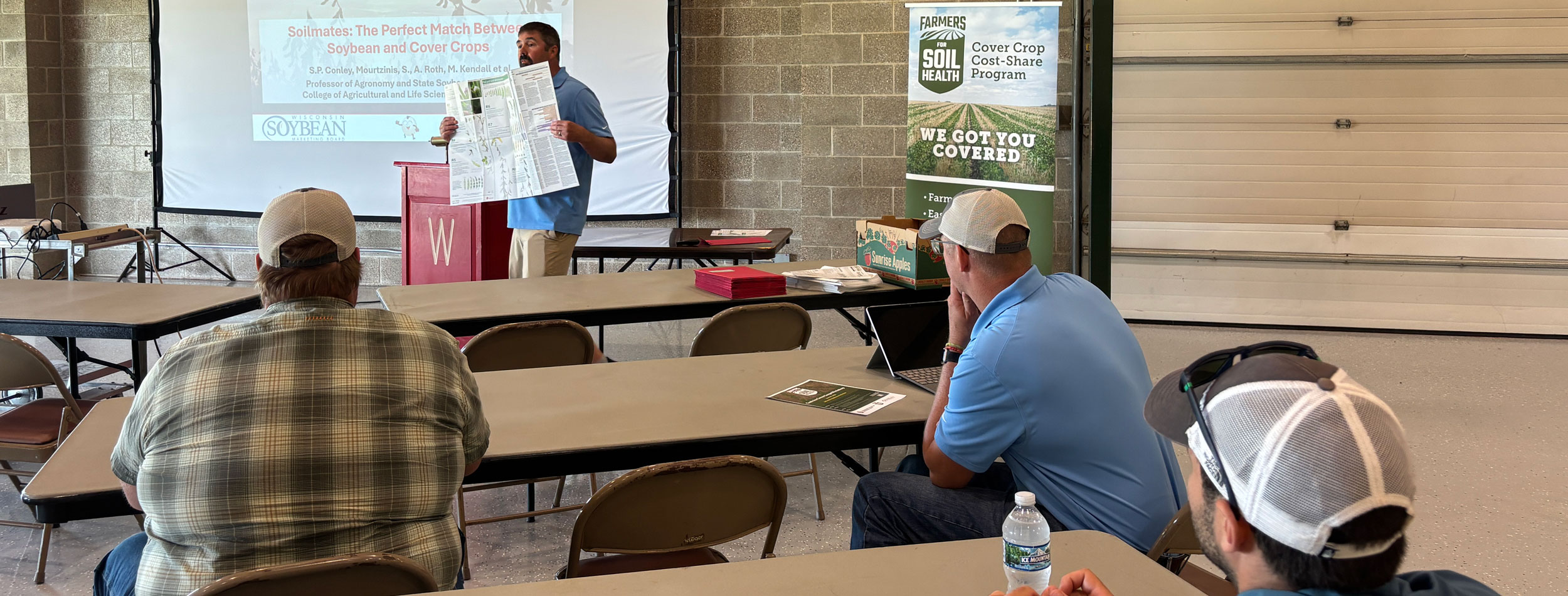
In reintroducing the FSH program, the Conservation Technology Information Center (CTIC) and Wisconsin Soybean Program teamed up June 25, 2026, for a pair of free educational “Cash for Cover Crops” workshops to encourage FSH enrollment and show how soy checkoff research investments are benefiting growers.
The Cash for Cover Crops workshops were held at Arlington Agricultural Research Station and later that day at the Crossroads Supper & Banquet Hall in Platteville.
Dr. Shawn Conley, a Wisconsin Soybean Association (WSA) director and state soybean and small grains specialist at the University of Wisconsin-Madison, spoke at both events on the “perfect match” between cover crops and soybeans. The backdrop of the Arlington Research Station proved an ideal fit for Conley’s message.
“The soil is so good out here, we can grow soy and corn on the gravel driveway,” Conley said, only half-joking, “just to give you a sense of the environment that we have here in the state of Wisconsin.”
Conley showcased some of the checkoff-funded research from UW-Madison, which can be viewed on the Badger Crop Network website, and explained to attendees how cover crops like cereal rye can beat the “guessing game” by suppressing weeds and reducing erosion and nutrient runoffs.
“From an ecosystem standpoint, cereal rye produces the most amount of biomass in a relatively inexpensive way,” Conley said, adding, “Cereal rye is a mode of action to address waterhemp. … With proper management, cover crops can be implemented and achieve our goals for biosystem health without sacrificing yields.”
WSA Director Danny Brisky, who also serves on the United Soybean Board, is early in his cover crop journey on his farm near Columbus.
“I decided it was time to try cover crops to loosen the soil and build weed suppression,” he said. “It doesn’t happen overnight, but we’re starting to see the benefits. It’s helping profitability, too.”
Brisky spoke alongside fellow farmer Nancy Kavazanjian and UW-Madison Weed Scientist Rodrigo Werle on a panel that delved into the importance of soy checkoff research, changes in growing practices and tips for producers interested in cover crops.
“We’ve had a lot of good luck with cover crops, and these cost-share programs really help because of all the extra seed and fuel costs,” said Kavazanjian, who represented Wisconsin on the United Soybean Board and estimated she’s grown cover crops for 25 years. “These programs help to offset those costs.”
Werle said soy checkoff support and farmer feedback are critical to supporting his research efforts.
“Without the sponsorship of the Wisconsin Soybean Marketing Board (WSMB), it’s hard to do this and secure research funding for cover crops,” he said. “I’m very grateful to the Marketing Board and also the United Soybean Board for helping us.”
Brisky also highlighted the differences between WSA and WSMB’s checkoff program and cited ways that WSA promotes voluntary soil health policies.
“We’re promoting in Madison the cover crop rebate program, which has been a really good program for our producers,” Brisky said.
Climate Outreach Specialist Amanda Latham spoke at the Arlington workshop on weather trends and outlooks, showing graphs indicating that warmer evenings are affecting the growing season in Wisconsin. Rick Bieber, a soil health adviser from the Fields of Sinsinawa, presented alongside Conley at the Platteville event.
Panting with a purpose: Understanding plant families
Farmers for Soil Health is a collaboration between the soy checkoff, pork checkoff and National Corn Growers Association. It launched in 2023 to advance the use of sustainable, soil health practices, including cover crops, to improve farmer profitability and promote conservation.
“Farmers for Soil Health is a great program that we’re glad to have the checkoff programs support, because it’s adding value to our farms by making it easier for our producers to invest in cover crops,” Brisky said.
Wisconsin growers earn several advantages when they invest time and resources into cover crops, including improved soil organic matter, enhanced weed suppression and carbon sequestration.
The updated highlights of the FSH program in 2026, with technical support from CTIC, include:
- Flexible one-year contracts
- $35 per acre
- All acres are eligible regardless of management practice from the previous year (no additionality)
- 2,000-acre cap per FSA farm entity
- Guided enrollment support with our soil health specialists
- Farmer-to-farmer support network with CTIC’s Cover Crop Coach program
- Stackable with many state, local and private-entity programs
- Simple verification process
The enrollment deadline for FSH is Aug. 31, 2026.
“This is a program that’s available to all farmers regardless of cover crop history,” said Teagan Duffy, CTIC’s Wisconsin soil health specialist. “It’s a statewide program.”
For more details, and to pursue next steps for enrolling in FSH, visit ctic.org/farmers-for-soil-health-inquiry/.
Click here to learn more about Wisconsin’s cover crop standards.