Farmers press case for rules-based trade at Westby listening session
Share This
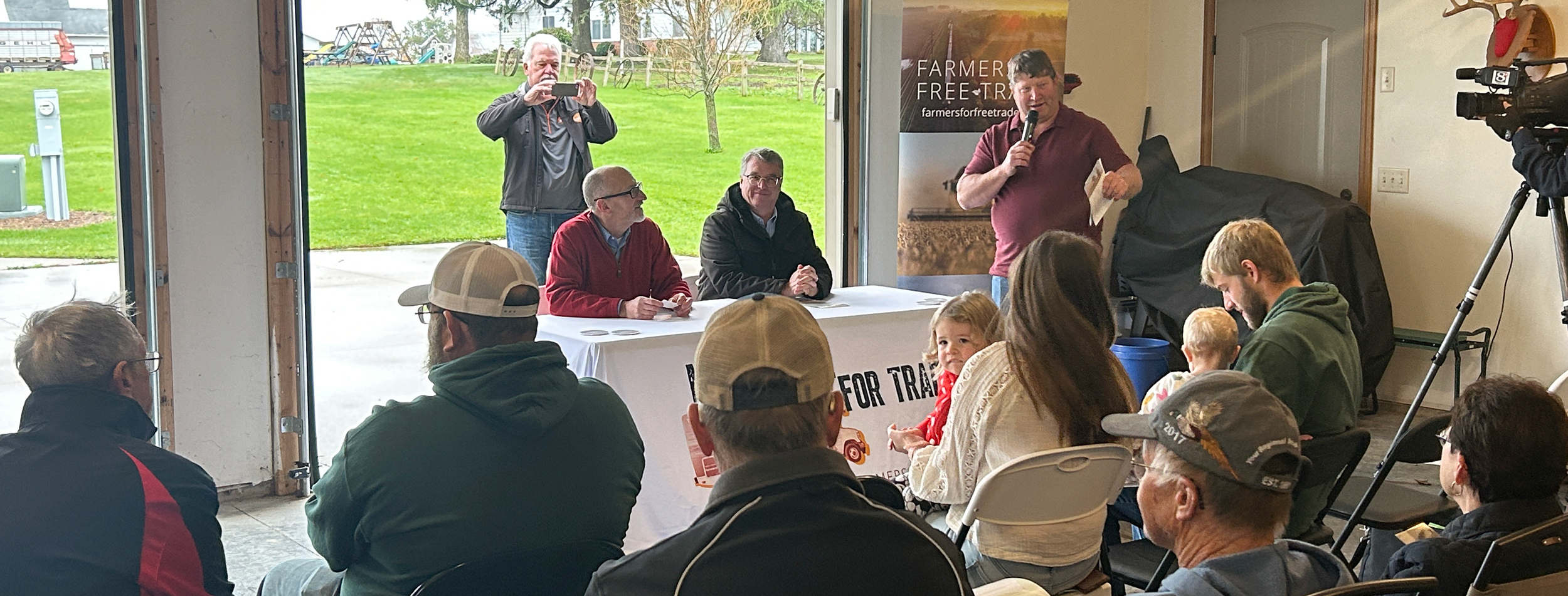
Transportation bottlenecks, tariff uncertainty and falling prices topped farmer concerns at a Westby listening session hosted by Farmers for Free Trade, where state and grower leaders urged a steadier, rules-based approach to trade alongside stronger domestic markets.
The stop was part of Farmers for Free Trade’s Motorcade for Trade, a two-month Midwest tour collecting farmer input before wrapping up in Washington, D.C., on Nov. 5. Executive Director Brian Kuehl said the group’s goal is to carry farmer stories directly to Congress.
Watch a video from the event here.
“If markets are allowed to work, by and large things will be okay,” Kuehl said. “That doesn’t mean there’s no role for government. It means great countries keep their word. We negotiate agreements, then we honor them.”
Kuehl pointed to the US-Mexico-Canda Agreement dispute panel that in December 2024 found Mexico’s proposed GMO corn restrictions weren’t science-based. He said that outcome shows why consistent, rules-driven enforcement matters to farm country. By contrast, he warned that launching tariff fights with allies undercuts leverage where it’s most needed.
“We should be aligning with allies to address real problems with China rather than fighting everyone at once,” Kuehl said.
State Sen. Brad Paff, D-Onalaska, framed policy choices in terms of kitchen-table economics for both farm and non-farm families.
“When we walk away from trading partners or let supply chains break down, it causes havoc on the farm and for working families trying to fill a grocery cart,” Paff said. “We need to do better.”
Paff also highlighted sustainable aviation fuel as a domestic demand opportunity for soy oil. He said legislation in Madison would steer incentives to growers to help build out supply, noting Minnesota’s airline-focused approach as a point of contrast.
Darin Von Ruden, who hosted the event on his farm and serves as president of Wisconsin Farmers Union, said anxiety has climbed as prices slid faster than typical harvest pressure.
“Markets that took decades to build are threatened by broad tariff wars,” Von Ruden said. “Farmers’ best tool is our elected officials. We need them to make sure our voices are heard and that we get a farm bill done.”
With the Mississippi River nearing freeze-up, farmers said transportation is complicating marketing decisions. Craig Meyer, who farms near Osceola, said many neighbors rely on river terminals at Winona, Minn., and La Crosse for export shipments.
“Basis is terrible,” Meyer said. “There’s almost an 80-cent carry to hold beans until the river opens — about 50 cents on corn — so everyone’s scrambling for storage and still trying to cover fall bills.”
Meyer added he rented extra bin space to sit on as much of his crop as possible.
Sara Stelter, a director with the Wisconsin Soybean Association who also serves on the United Soybean Board, outlined how checkoff investments are working to cushion the blow by building domestic demand — from biodiesel used by major rail lines to soy-based firefighting foams, industrial adhesives and tire compounds through partnerships with manufacturers like Goodyear.
“We’re pushing new industrial uses and fuels while continuing to develop international markets,” she said. “It’s about resiliency at home and reliability abroad.”
Producers at the session also cited rising input costs for fertilizer, crop protection and parts.
“Farmers are paying more for everything and getting less for their products,” Kuehl said. “That’s a recipe for losing farms.”
Despite the headwinds, speakers said the path forward is clear: keep North American trade predictable, target bad actors with coalitions rather than scattershot tariffs, and keep investing in domestic demand that can absorb more U.S. soy and corn when export channels tighten.
“Wisconsin helps feed the world through protein,” Paff said. “We need to be running on all eight cylinders — strong trade relationships abroad and stronger supply chains at home.”