Perfect blend of experience lifts UW-Madison to NAMA title
Share This
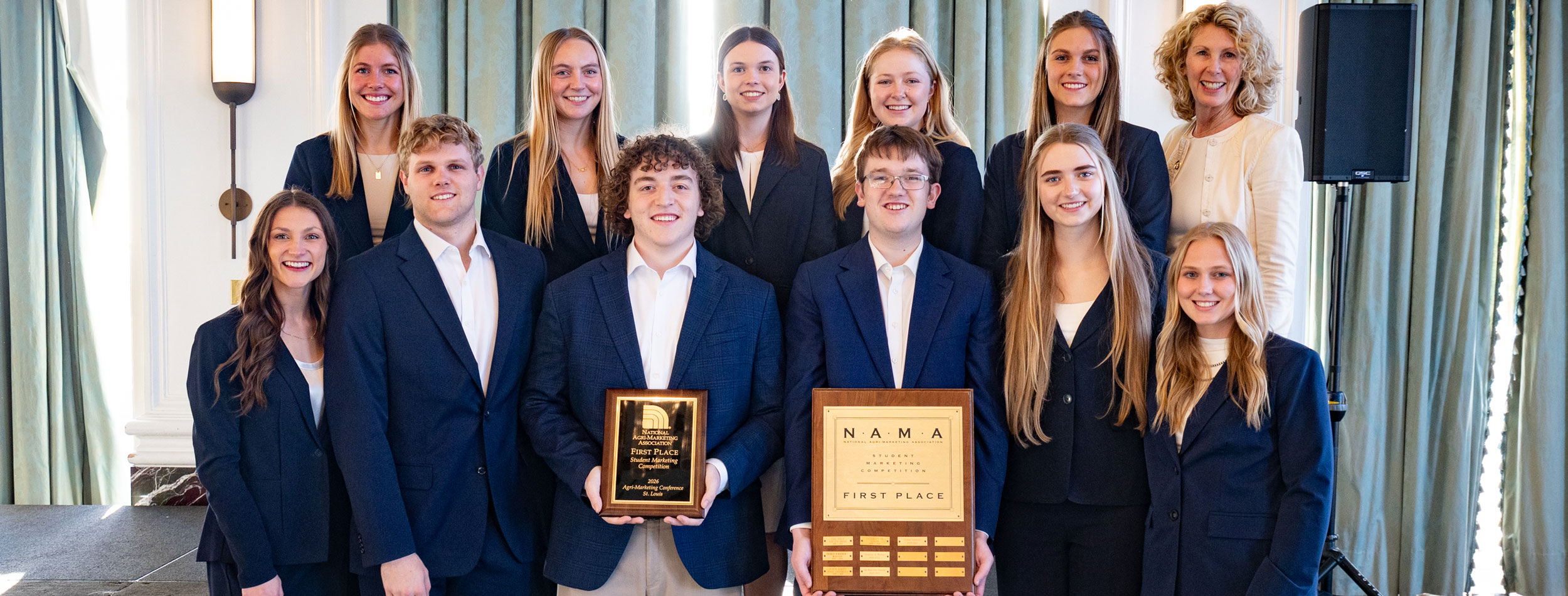
Anna Marie Martin knew they had a chance. The University of Wisconsin-Madison NAMA president had just poured her heart and soul into the national collegiate competition with her fellow teammates.
“I remember we were sitting there waiting for the results, and it was like sixth place was called, fifth, fourth, third,” Martin said. “And then they were about to announce second, and we hadn’t been announced yet.”
What felt like forever unfolded in a matter of seconds.
“I just turned to everyone and I was like, ‘Guys, no matter what, we got first or second in the national competition.’ And then as I’m whispering that to everybody, I get cut off and it’s like, ‘Purdue University got second place.’
Soybeans for the win
The Badgers pulled off the national title thanks to the miracle bean and a hypothetical new variety and process that is being researched at the University’s Wisconsin Crop Innovation Center.
While most teams at the National Agri-Marketing Association’s collegiate competition focus on one product, the Badgers took a two-pronged approach: A soybean variety and an extraction process that produces natural red dye to replace synthetic dye in food and beverages.
Sarah Botham, faculty for the College of Agriculture and Life Sciences Communications program at UW and the advisor for the University’s NAMA chapter, said she is always on the hunt for ideas for the next year’s competition and delivers those to the students the day they get back from the competition.
“The products for next year (2027) have already started to roll,” said Lauren Breunig, a senior on the team. “It’s really a team effort. We all go through research that’s coming out, mostly led by Sarah. She does a really great job reading up on emerging research in the ag field.”
Martin and Breunig both knew they were onto something when Botham gave them information on a food-grade red dye being made from soybeans. But they also knew there was a challenge ahead. How do you market the red dye when the soybean seed was equally important? Two different products meant two different marketing plans to consider across the business model.
For Botham, that was ok. She had faith in her class.
“This was a really unique group of students,” Botham said. “I only had four or five returning students, so that means seven of them were new. They came to the table ready to learn and ready to dive in, which is really extraordinary.”
A new variety
Among those new faces was senior Emma Paulson, who grew up on a dairy farm. Her father, Alan, and brother, Kyle, grow corn and soybeans as well as sell Pioneer Seed.
“We had been heavily recruiting another one of the seniors for this year, Emma Paulson,” Breunig said. “She has some great connections within the soybean industry. Her dad is a Pioneer rep. So being able to bring in someone who had those connections inspired us to reach out to producers this year, which we hadn’t done in the past.”
Paulson said there was a lot of synergy between the returning students and the fresh faces.
“The coolest thing about NAMA is that we had a kid that was in a frat like from California (Jonathan “Jack” Chittick), who didn’t have an ag background, but he excelled so well with the whole red-dye market,” Paulson said. He found all of our competitors, went through all the bans, the laws, the legislation and stuff like that.”
Botham complimented Chittick on his dedication to researching the marketplace.
“By the time the competition rolled around, he knew all there was to know about food and beverage dyes,” she said.
Breunig echoed that sentiment, noting that with new faces came new ideas.
“At the end of last year, we were all really scared coming back with a really limited number of veteran students,” Breunig said. “It couldn’t have worked out better. I think having so many new faces forced us to take more time to think about why we’re doing everything. At some points, we were like, ‘Well, this is what we did last year.’ And there would be a new member, and they were like, ‘Then why are we doing it this year?’”
The NAMA experience
For the students who took Botham’s class, worked on the project and competed, whether behind the scenes (graphic designers, writers, IT, research) or as a presenter, the experience helped build new skills and open new doors.
Breunig was offered a job at STgenetics before her senior year started. She’ll start full time after graduating in May. Martin is going to grad school to study Environmental Education where she hopes to help vulnerable communities tackle the rising temperatures in urban areas.
For Paulson, one-year in NAMA was more than worth its weight in gold.
“I’ve told basically everybody that if I didn’t do NAMA, I truly believe that I would have just gotten a mediocre experience out of my time at UW Madison,” Paulson said. “I didn’t have any jobs lined up before going to NAMA, and then after NAMA, I made all these connections, met all of these great people, and it opened doors for me.”