Field day highlights value of soybean research
Share This
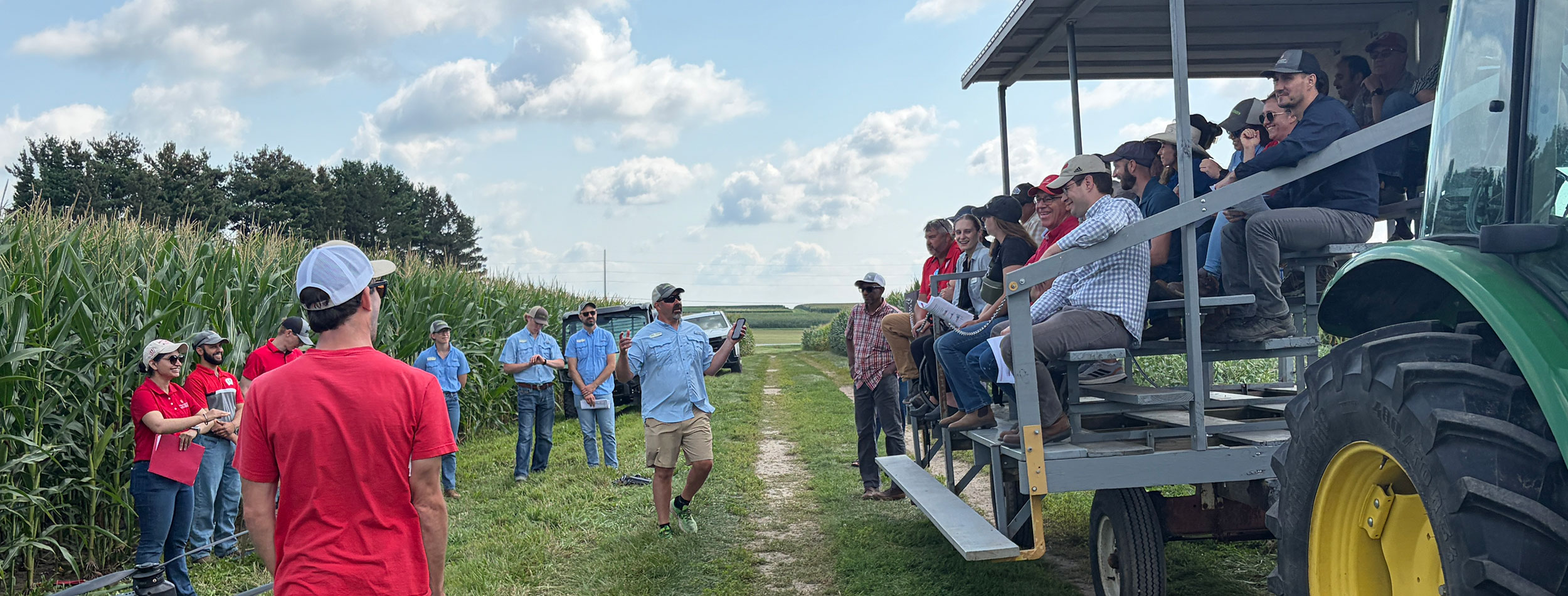
Soybean growers received an up-close look at checkoff-supported research during the University of Wisconsin-Madison Agronomy and Soils Field Day Aug. 26 at the Arlington Agricultural Research Station.
The annual event brought researchers, graduate students, farmers and agricultural professionals into the field to discuss ongoing work involving corn, soybeans and soil management. For soybean growers, the program demonstrated how research investments are addressing immediate production questions while building knowledge for the future.
Dr. Shawn Conley, the UW’s soybean agronomist and small grains specialist, told attendees the Wisconsin Soybean Marketing Board provides a majority of the money for soybean research in his program.
“We’re proud of the work Shawn and his team do,” said WSMB President Johnathan Gibbs. “Their research benefits farmers on many different levels, from reducing inputs to increasing yields. We feel this is a good use of soy checkoff investments.”
Graduate students shared updates on projects examining soybean fertility, disease management, crop rotation and nitrogen use.
Rianne Wagner is working to develop Wisconsin-specific guidance for tissue potassium concentrations and determine whether in-season applications can correct deficiencies. Results have varied by location, underscoring the importance of soil conditions, application timing and local data.
Bryce Himmelberg compared fungicide applications made by spray drone and ground-based equipment for white mold management. Results to date showed similar disease control and yield responses between the two methods, although researchers said additional evaluation under white mold pressure is needed.
Taiha Hebel examined the potential for planting soybeans in consecutive years. In a long-term rotation trial, second-year soybeans yielded only 0.4 to 0.9 bushels per acre less than soybeans in a corn-soybean rotation. The work suggests the yield penalty may be smaller than anticipated, although weather, soil conditions and management remain important.
Other research focused on soybean biological nitrogen fixation and whether supplemental nitrogen can improve yield or seed quality. Findings showed soybeans obtained about 82% of their total nitrogen through biological fixation, with most of that nitrogen allocated to the seed.
Conley said the field days are a culmination of a lot of hard.
“I think it’s great to see students translate the hundreds of hours of work from the research into digestible nuggets and communicate that with farmers who fund our program,” Conley said. “They get to show the value of the research funded by the Wisconsin soy checkoff, and farmers get to see their dollars at work.”
USDA seeks input on data modernization
Following the field day, USDA Under Secretary for Farm Production and Conservation Richard Fordyce and Chief Economist Justin Benavidez hosted a listening session focused on modernizing USDA data collection.
USDA is exploring changes as producer response rates to traditional surveys continue to decline. Improving acreage and yield estimates is a central goal, along with developing modernized digital acreage reporting that could allow information to be shared more quickly.
Participants discussed ways to reduce the burden on farmers, including shorter, more frequent surveys and forms pre-populated with information USDA already has.
The Arlington session was part of a nationwide effort to gather producer feedback as USDA develops its data modernization plan.